



When it’s past the plunger stage
One slow drain that just started? Try a plunger first, or a basic hand snake. That’s honest advice and we’d rather you not call us for something you can handle yourself in five minutes.
But these situations are different:
- Same drain backing up repeatedly, you clear it and it comes back within weeks
- Gurgling sounds in the toilet when you run a sink or shower in another part of the house
- Sewer smell coming up through drains that doesn’t go away
- Water from one fixture backing up into another, sink draining into a tub for instance
- Multiple slow drains at the same time
Multiple fixtures going slow simultaneously almost always means the main line, not individual clogs. That’s a different conversation with different stakes.
Main sewer line issues vs. one clogged drain
This distinction matters more than most people realize and it’s where a lot of drain cleaning companies get it wrong.
Your home’s drain system has a main line, the highway everything flows through on its way to the city sewer. Branch lines feed into it from individual fixtures. A clog in a single branch line is localized. A partial blockage in the main line affects everything downstream of it, which is usually most of the house.
Treating a sewerr line issue like a single-fixture drain clog is how you end up with a drain that clears, works fine for two weeks, and backs up again. We diagnose which one we’re dealing with before we recommend anything.
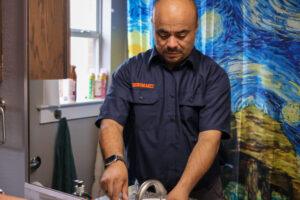
Camera inspection. This is how we know the root cause.
A lot of plumbers skip this step because it adds time and they’d rather just clear the line and move on. We’d rather know what’s in the pipe before we start working on it. The camera shows us exactly where the blockage is, what it’s made of, what condition the pipe walls are in, whether there are roots, a belly, or damage that clearing alone won’t fix. For a first-time clog on a relatively new drain it might not be necessary. For anything recurring, any main line issue, or any situation where multiple fixtures are involved, it changes the recommendation almost every time.
Worth mentioning: if you’re buying an older Austin home, a sewer camera inspection before closing is worth every dollar. Foundation movement here is significant and ongoing. Pipes shift. Lines that are partially compromised can look fine on the surface for years before they become a problem. Finding out before you own the house is a different situation than finding out after.
Hydro jetting vs. drain snaking. They’re not the same thing.
Snaking punches a hole through a clog. That’s it. The clog is gone but the buildup that helped create it is still coating the pipe walls, and it’ll catch debris again and rebuild faster than the original did.
Hydro jetting uses high-pressure water, professional equipment typically runs somewhere in the 1,000 to 3,000 PSI range, to scour the pipe walls clean. Grease, sludge, mineral deposits, soap buildup, all of it. The result lasts longer because you’re actually cleaning the pipe instead of just clearing the immediate obstruction.
We don’t recommend jetting for every situation. Older or already-damaged pipes aren’t always good candidates and we’ll tell you if yours isn’t. But for kitchen lines with grease history, main lines with buildup, or any drain that keeps coming back, it’s usually the right call.
When the real problem isn’t a drain clog
Root intrusion that keeps coming back after cleaning means the roots have a way in and they’ll keep using it. A pipe belly means waste is pooling in a low spot and no amount of clearing will change the physics of that. A cracked or offset joint means water and waste are escaping somewhere they shouldn’t be.
These situations need repair, not just cleaning. We’ll tell you directly if that’s what we’re seeing and walk you through what the repair involves. No pressure. Just what the camera showed us and what the options are.
One thing about chemical drain cleaners
If you’ve already poured something down the drain before calling us, tell us when you call. Corrosive chemicals sitting in a pipe create a real safety issue for the person working on it. Mixing different products, even accidentally, can produce dangerous fumes. Poison Control and MedlinePlus both flag serious injury risk from contact with these chemicals.
For anything persistent, professional cleaning is faster, safer, and doesn’t leave a chemical problem behind in the pipe.
Keeping drains clear
Drain screens in showers and tubs. Grease in the trash, not the sink. Hot water after washing dishes. Toilet paper only, flushable wipes are not flushable in any practical sense and we see what they do to lines regularly. Older homes with recurring issues benefit from proactive cleaning on a schedule rather than waiting for a backup.
How far we will go to clear your drain
We service Austin, Round Rock, Pflugerville, Cedar Park, Leander, Lakeway, Buda, Kyle, Manor, and surrounding areas. Schedule drain cleaning now at (512) 575-4377, live answer. Or book online.